Thursday, October 27, 2005

Sales Training CDs/Videos

  1. Richardson Training System
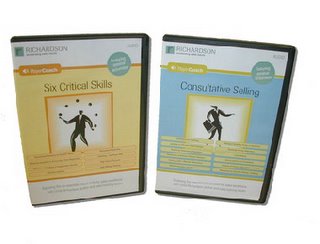
Richardson Live is a series of concise, hard hitting audio tracks that cover the critical sales strategies and skills you need to win profitable business and strengthen relationships.

Linda Richardson, industry leader and founder of Richardson, a dominate provider of sales training and consulting, covers the key teaching points around hot topics that salespeople and support team members must know (and do) to achieve their objectives and improve their results.

Each Richardson Live course is:

  • Concise and Condensed - each disk contains up to 12, 3-5 minute audio tracks
  • Most Demanded Coaching Topics - brings the hottest and latest topics from seminars and workshops
  • Easy to Use - can easily be played on most computer systems, portable compact disk players, MP3 players, and Pocket PCs, and PDAs
  • Proven - captures 25 years of experience coaching to top sales teams across industries
  • Effective - gets you ready for sales calls and helps you prepare for meetings
  • Integrated - fully aligned to all Richardson training

The Richardson Live Series Includes:


2. Ziglar Training System


Building the Sales Professional and the Sales Person
In this fast-paced and humorous approach to selling, Bryan Flanagan shares valuable ideas on how to invest in yourself and in your sales career. These insights will help you move ahead in the world of selling.


3. Sales Training Camp

Volume 1 :
For an outline of each cd, please click on a link below:Volume 2 : For an outline of each cd, please click on a link below:

4. Peak Sales Consulting

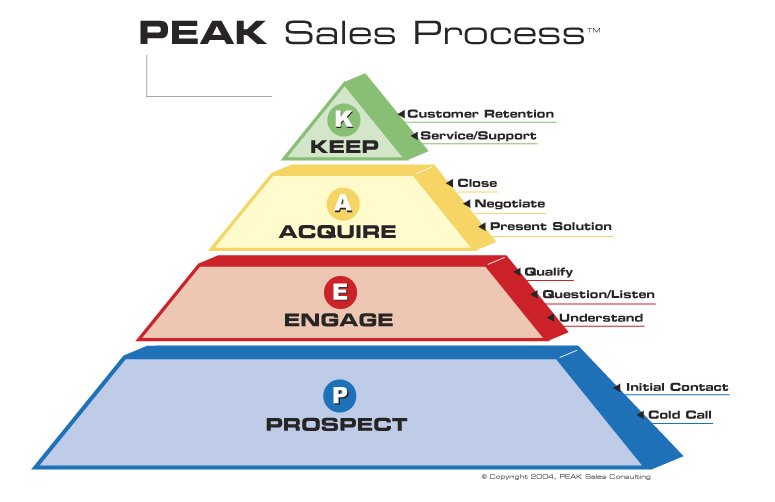
This Sales Training TeleSeminar Series covers the PEAK Sales ProcessÔ. PEAK stands for Prospect, Engage, Acquire, and Keep, the four basic steps of an effective sales process. Each of these steps requires specific sales skill training which is fully covered in this series.

Use this CD-based sales training course for individual and company sales training, for indirect and direct sales training, for in house sales training, for motivational sales training, or for all your organization sales training requirements.


5.Other Interesting Sales Training CDs

In today's world, you need every edge to close a sale. These programs are geared toward revealing the secrets of selling from the pros. For complete details on any title, click on the links below

ball24 Techniques For Closing The Sales Training
Learn how to be an excellent closer with Brian Tracy's "24 Techniques For Closing The Sale"

ballAdvanced Selling Techniques
A powerful resource for the seasoned sales pro

ballGuerilla Selling Sales Training - Live!
Learn how to out think competitors, crush quotas, and produce more sales and personal income than ever before

ballTeleCoach
Telephone sales training with a powerful dose of reality

ballSales Training on CDs
Assorted sales Training Courses on Interactive CD-ROMS


ballLow Profile Selling
The key to selling is to build long-lasting relationships with the customers and this program will help with that

ballThe New Strategic Selling
by Diane Sanchez and Stephen E Heiman - Master the worlds leading sales system

ballProfessional Patterns of Selling
by Jack and Gary Kinder

ballPsychology of Selling
With Brian Tracy's Psychology of Selling you will learn how to program yourself for success

ballNegotiate Like the Pros
Never pay too much, settle for too little or give in too soon again

Tuesday, October 11, 2005

Sales Territory Design

Sales territory designing can be an extremely powerful sales force productivity tool.Sales Managers should evaluate, align, re-align, or optimize sales territory design , and communicate the results to sales people via easy to understand reports. This is critical to
  • optimize sales force efficiency and selling time
  • balance territory workloads and earnings potential
  • improve sales force satisfaction and morale
  • minimize travel time and costs, and improve customer coverage
  • better manage resources and generate more revenue per coverage area
The process of Territory Design starts with need identification or opportunity analysis

Opportunity onepixel.gif (799 bytes)
  • Effectively manage and allocate limited sales staff
  • Align coverage
  • Balance workloads and expectations
  • Meet projected needs
  • Meet customer & prospect needs
  • Expand service
  • Target competitors
onepixel.gif (799 bytes) onepixel.gif (799 bytes)
Process
  1. Understand existing territories – analysis variables relationship such as, customers, prospects, product coverage and sales force location
  2. Understand sales force related variables – captive or independent, level, product mix, customer mix, involvement in process
  3. Build the in-house data file
  4. Determine alignment variables – coverage, number of customers, prospects, size, existing sales, potential
  5. Determine number of territories – ideal or budgeted
  6. Design and optimize territories
  7. Balance with secondary variables
  8. Update internal databases
  9. Support roll-out process
onepixel.gif (799 bytes) onepixel.gif (799 bytes)
Tools
  1. Performance Analysis
  2. Map Analysis
  3. Alignment
  4. List Development & Acquisition
  5. Model Requirements
  6. Channel Conflict Management
  7. Distributor Potential Studies
onepixel.gif (799 bytes) onepixel.gif (799 bytes)


TOP down vs Bottom Up approach

There are two widely accepted methods of developing a sales hierarchy: bottom-up and top-down. These terms refer to the order used when building your sales structure. A bottom-up approach begins with the creation of the territories. When the territories are complete, they are grouped together to form districts. Then, when the districts are complete, they are grouped together to form regions.

The top down approach is simply the same process in reverse. First, regions are constructed. Next, districts are constructed within each of the regions. Finally, territories are constructed within each of the districts.

Both approaches offer advantages and disadvantages, but in most cases, your current situation will determine the approach that you take. If your district or region boundaries are fixed and not in need of change, you have to decide whether you want to build territories first and then group them together to form districts and then regions, or define your regions and districts first and then create your territories within the newly defined district boundaries. If you already have established territory, district and region boundaries, your task may be more of a fine-tuning than a realignment. On the other hand, if you need to change the total number of areas, regions, districts or territories, you may find it easier to start from scratch, using either approach.

Case studies : Focus on understanding concept of Territory realignment . Pl send in your request for a real life case study as a comment to this article

Reference Articles : Sales Territory Alignment


Monday, October 10, 2005

Sales Force Design

The sales force is a company’s most critical customer contact point and has a direct impact on its top line. For many firms, it is not only the most valuable and expensive asset—costing up to 40% of sales—but also the most complex. Sales force design merits close attention because it can have significant impact on costs, customer coverage and revenue.

Sales force design encompasses three issues:
  • The structure of the sales force—defining roles, formulating teams and establishing reporting relationships
  • The investment in the sales force—determining the appropriate investment level for the overall selling organization
  • The allocation of effort and assignment of roles—across products, customer segments and sales force activities

Senior managers regularly struggle with the complicated issues surrounding these important decisions. While many benefits of a new sales force design—such as growing revenue and creating a scalable, flexible organization—are realized in the future, the immediate impact can be a downturn—due to one-time investment costs as well as organizational and customer disruption. The implications of downsizing or upsizing the sales organization must also be carefully considered. Developing the right solution requires a process that combines objective, fact-based analysis with the collective experience of the sales managers

In case you are planning to restructure or study your sales force design follow the below stated points

  • Develop a process that links upstream decisions such as customer segmentation and value proposition with downstream implementation considerations such as customer disruption, territory design and micro-marketing
  • Adopt an objective and fact-based approach to decision-making by incorporating internally- and externally-available data and leveraging collective management experience
  • Create recommendations for the most appropriate sales force structure, overall investment level, role assignment and resource allocation
  • Understand the implications of various external and internal events on the final recommendation
  • Implement change so as to minimize the impact of customer disruption and enhance long-term benefits

Reference Books :


This is a sourcebook for strategic sales force planning and management, delving deeply into core issues of sales force design, including examples and practical frameworks, it is written for sales executives and managers with strategic sales responsibility.
The insights presented in this book can help successfully create, expand, downsize, merge or restructure a sales organization for maximum impact in today’s rapidly evolving business environment. With its strategic focus, the book is uniquely positioned to drive effective sales force strategy and implementation.


Other Books of interest